
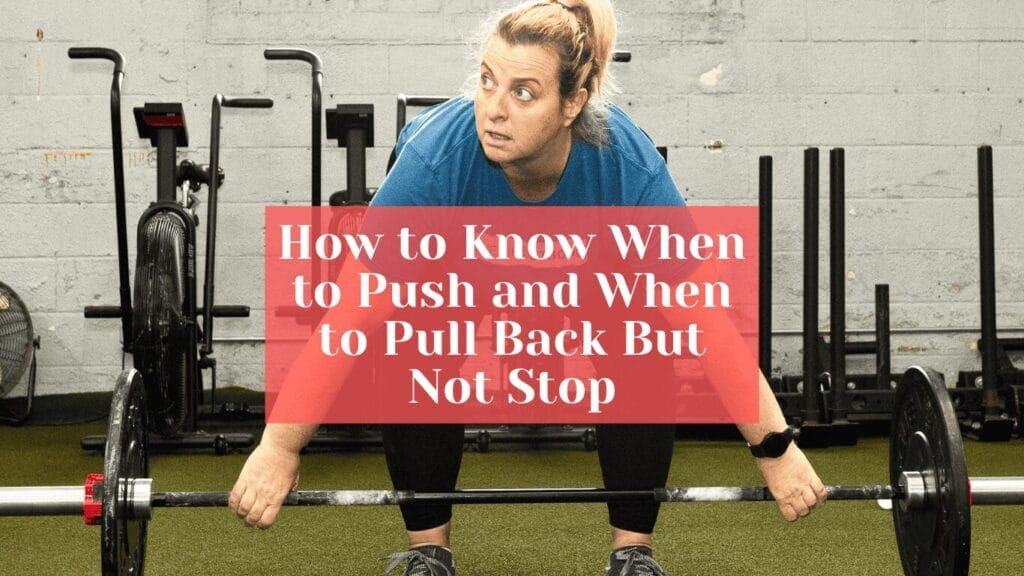
Avoiding Injuries How to Know When to Push and When to Pull Back But Not Stop
One of the hardest parts of training as a busy adult isn’t effort.
It’s judgment.
Knowing when to push harder…
When to back off a little…
And when stopping completely is actually the worst move you could make.
I see this all the time in the gym. People swing between two extremes. They either push through everything until something flares up, or they feel one ache and shut it all down for weeks.
Both usually lead to the same place: stalled progress and frustration.
The middle ground is where long-term results live.
Why This Is Harder as an Adult
When you’re younger, your body forgives a lot. Bad sleep, stress, poor warm-ups — you can still muscle through workouts.
When you’re juggling kids, work, stress, and limited time, that margin for error shrinks fast.
Some days you feel great.
Some days everything feels heavy before the warm-up is over.
That doesn’t mean you’re weak.
It means you’re human.
Good training accounts for that instead of pretending every day should feel the same.
There Are Only Three Smart Training Decisions
Every session, whether you realize it or not, you’re making one of three choices:
You push.
You hold steady.
Or you pull back — without stopping.
All three are correct depending on the day.
The mistake is thinking only one of them “counts.”
When It Makes Sense to Push
Pushing doesn’t mean ego lifting. It means you’re ready to apply a little more stress.
Some signs:
Your warm-ups feel smooth and pain-free
Movement feels crisp and controlled
Weights move well without grinding
You feel energized, not forced
On these days, adding weight, reps, or intensity makes sense. This is where strength and muscle are built.
The key is that the push feels earned — not emotional.
When Holding Steady Is the Right Call
This is the most underrated option.
Holding steady means:
Same weight
Same reps
Same quality
And that’s not wasted time.
If you’re sleeping less, work stress is high, or you’re still a little sore from the last session, maintaining is a win.
Progress doesn’t only come from adding more.
It also comes from not losing ground during busy seasons of life.
As a married dad of three, I live this. Some weeks are about pushing. Some weeks are about not going backwards.
Both matter.
When You Pull Back (But Don’t Stop)
This is where most people get it wrong.
Pulling back does not mean quitting. It means adjusting.
This might look like:
Reducing load
Shortening range of motion
Slowing tempo
Changing the exercise variation
You’re still training the pattern. You’re just matching it to your current capacity.
For example:
Barbell deadlifts bothering your back? Elevate the bar or use a trap bar
Overhead pressing feeling rough? Switch to a landmine press
Deep squats not great today? Box squats or split squats
You’re not avoiding movement.
You’re respecting it.
This is how confidence and capacity come back.
Why “Stopping Until You Feel Better” Usually Backfires
Here’s the uncomfortable truth.
If you stop training every time something doesn’t feel perfect, you slowly lose the ability to tolerate stress.
Strength fades.
Mobility tightens.
Fear grows.
Then when you finally try to come back, everything feels worse.
Most aches aren’t solved by complete rest. They’re solved by better loading.
That’s why training around discomfort — intelligently — is often the fastest path forward.
Your Body Gives You Signals (If You Listen)
You don’t need to guess.
Your body tells you what it can handle if you pay attention:
Sharp or worsening pain → adjust immediately
General stiffness or soreness → warm up, move, reassess
Fatigue without pain → hold steady or reduce volume
This is what coaching really is. Not yelling. Not hype. Decision-making.
Internet programs don’t know how you slept.
Your ego lies to you.
Fear lies too.
Having a framework keeps both in check.
What Smart Progress Actually Looks Like
Long-term progress isn’t linear.
It’s small pushes forward, short plateaus, brief pullbacks — stacked over years.
Strong people aren’t reckless.
They’re adaptable.
They don’t panic when something feels off.
They don’t force bad days to become great ones.
They keep showing up.
Final Thought
If you wait for perfect conditions, you’ll wait forever.
The goal isn’t training at max intensity every session.
The goal is training in a way that lets you come back again tomorrow.
Push when it’s there.
Hold when life is heavy.
Pull back when needed — but don’t stop.
That’s how strength lasts.
